Mohamed Ramadan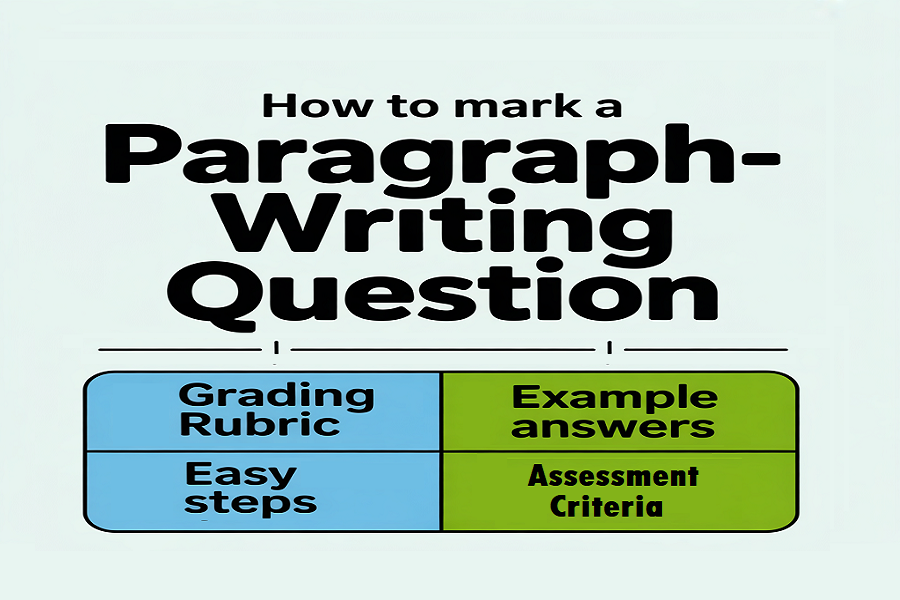
Effective writing assessment is crucial in helping students develop strong communication skills. This article will provide teachers with a clear, comprehensive framework for systematically and fairly marking a paragraph-writing question. By understanding key marking criteria and using symbols to correct students’ writing, we can offer meaningful feedback that supports student growth and learning.
Overview of Assessment Criteria
When marking a paragraph-writing question, we will focus on five essential components:
- Vocabulary
- Grammar
- Spelling
- Punctuation
- Relevance of Ideas
Each criterion contributes to the overall quality of marking a paragraph-writing question and provides a holistic view of students’ communication skills.
1. Vocabulary Assessment
Vocabulary Criterion:
Evaluate students’ word choice, diversity, and appropriateness. Look for:
- Age-appropriate word selection.
- Varied and descriptive language.
- Words that enhance the clarity of ideas.
Sample Student Writing: “The big dog ran fast” vs. “The enormous German Shepherd sprinted across the meadow.”
Assessment: The second example demonstrates a more sophisticated use of vocabulary.
2. Grammar Evaluation
Grammar Criterion:
Assess the structural integrity of sentences and overall language mechanics:
- Correct sentence structure.
- Appropriate verb tenses.
- Subject-verb agreement.
- Coherent sentence construction.
Sample Student Writing: “Me and my friend go to park” vs. “My friend and I went to the park”
Assessment: The second example shows proper grammatical construction.
3. Spelling Considerations
Spelling Criterion:
Examine students’ spelling accuracy, considering their grade level:
- Correct spelling of grade-appropriate words.
- Consistent phonetic understanding.
- Minimal spelling errors.
Sample Student Writing: “I wen to skool” vs. “I went to school”
Assessment: Reward progressive spelling improvement appropriate to the student’s developmental stage.
4. Punctuation Analysis
Punctuation Criterion:
Evaluate proper use of punctuation marks:
- Correct placement of periods, commas, and question marks.
- Appropriate capitalization.
- Clarity enhanced by punctuation.
Sample Student Writing: “lets go to the store” vs. “Let’s go to the store!”
Assessment: The second example demonstrates proper punctuation and capitalization.
5. Relevance of Ideas
Ideas and Content Criterion:
Assess the substance and coherence of the writing:
- Clear understanding of the writing prompt.
- Logical flow of thoughts.
- Appropriate detail and explanation.
- Engagement with the assigned topic.
Sample Student Writing on “Social Media”: Evaluate how well the student addresses the specific writing topic and communicates their ideas.
Grading Rubric Framework
Develop a point-based or percentage-based rubric:
- Vocabulary: 20%
- Grammar: 20%
- Spelling: 20%
- Punctuation: 20%
- Relevance of Ideas: 20%
This balanced approach ensures a comprehensive assessment.
Supportive Feedback Strategies
Provide constructive feedback to support the assessment for learning:
- Use positive, encouraging language.
- Highlight strengths.
- Offer specific suggestions for improvement.
- Focus on growth and learning.
Remember: The goal is to motivate and support student development.
Conclusion
Marking a paragraph-writing question is an art and a science. By applying these systematic criteria, we can:
- Provide fair and comprehensive evaluations.
- Support student writing development.
- Encourage continuous improvement.
- Foster a love for written communication.
Continue to refine your assessment skills and stay responsive to individual student needs.
Write Emails That Get Results—Every Time!
Tired of second-guessing your business emails? Our Business Email Toolkit gives you everything you need to communicate with clarity, confidence, and professionalism.
* 20+ Editable Email Templates—Save time with ready-to-use formats for every scenario.
* Professional Phrases Bank—Sound polished and natural in any context.
* Tone & Grammar Guides—Avoid mistakes and miscommunications.
* BONUS: “Say It Right” eBook—Advanced strategies for persuasive writing.
Perfect for professionals, freelancers, teachers, and non-native speakers.
Get Your Toolkit Here
Want to get certified to teach English abroad or online? Click below to get your Free TEFL guide

About the Author