Mohamed Ramadan
For many non-native English teachers, professional development used to mean collecting certificates, downloading PDFs, attending random webinars, and purchasing methodology books that often remained half-read. The days of buying a lot of books with the idea of getting a LOT of knowledge are over.
More information does not automatically mean more competence.
Today, professional growth in English language teaching requires a different mindset. It is no longer about consuming more content. It is about applying, reflecting, refining, and specializing.
If you are a non-native English teacher, this shift is even more important. Your credibility, clarity, and classroom confidence depend not on how much theory you know but on how effectively you translate knowledge into classroom impact.
Let me now assist you with your anticipated query: What is the best growth strategy in ELT?
1. Stop Collecting Knowledge. Start applying it.
Many teachers believe:
“If I just read more, I’ll become better.”
But growth does not come from passive consumption. It comes from deliberate implementation.
Instead of:
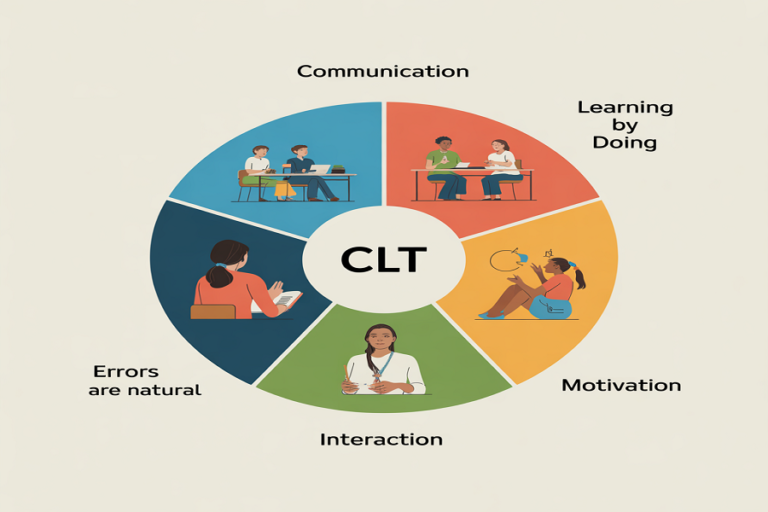
- Reading five books on Communicative Language Teaching
- Watching ten videos on lesson planning
- Saving twenty articles on assessment
- Choose one idea.
- Apply it in your classroom.
- Reflect on the outcome.
- Adjust
That cycle—implementation, reflection, and refinement—is the foundation of professional growth in ELT.
2. Build Depth, Not Just Breadth
Non-native English teachers often feel pressure to “know everything.” Grammar mastery, pronunciation accuracy, methodology, classroom management, technology, exam preparation…
But sustainable growth comes from depth.
Choose a specialization:
- Speaking-focused instruction
- Business English
- Exam preparation (IELTS, TOEFL, Cambridge)
- Young learners
- Academic writing
- Teacher training
When you build depth, you:
- Gain confidence
- Become more marketable
- Deliver clearer results to learners
Professional growth in ELT is not about becoming everything. It’s about becoming excellent at something.
3. Strengthen Your Core Teaching Skills
Before advanced certifications, focus on mastering fundamentals.
Ask yourself:
- Can I write measurable lesson objectives?
- Can I design clear input activities?
- Can I move students from controlled to communicative practice?
- Can I balance fluency and accuracy?
- Can I manage classroom interaction effectively?
Many teachers skip the foundation and chase trends.
But strong foundations lead to long-term professional growth in ELT.
4. Develop Reflective Practice
The most successful teachers are reflective practitioners.
After each lesson, ask:
- What worked?
- What confused students?
- Did my activities match my objective?
- Did I talk too much?
- Did students produce enough language?
Reflection transforms experience into expertise.
Without reflection, even 10 years of teaching may simply be one year repeated ten times.
5. Improve Your English Intentionally
As a non-native teacher, your English proficiency remains part of your professional identity.
But improvement should be strategic, not random.
Focus on:
- Classroom language clarity
- Pronunciation accuracy
- Collocations and natural expressions
- Functional language for feedback
Instead of memorizing rare vocabulary, improve the language you actually use when teaching.
Confidence in your own English supports stronger professional growth in ELT.
6. Learn to Design Strong Lessons
A powerful growth strategy is mastering lesson design.
Every effective lesson includes:
- Clear objective
- Logical staging
- Effective input
- Controlled practice
- Communicative output
- Feedback
- Reflection
When your lesson structure becomes solid, your teaching confidence increases dramatically.
Professional growth is visible in your planning quality.
7. Stop Comparing Yourself to Native Teachers
Comparison slows growth.
Your value as a non-native teacher includes:
- Understanding learners’ struggles
- Anticipating L1 interference
- Modeling successful language learning
- Providing structured explanations
Your journey is your strength.
Growth happens when you refine your advantages—not when you imitate others.
8. Build a Professional Identity
Modern ELT growth includes visibility.
Consider:
- Writing articles
- Sharing teaching insights
- Creating short videos
- Developing teaching resources
- Building a niche blog
Professional growth in ELT today is not only internal—it is also professional positioning.
When you share knowledge, you clarify your thinking.
And clarity strengthens competence.
9. Choose Strategic Professional Development
Instead of random webinars, choose development that:
- Solves a real classroom challenge
- Builds a core teaching skill
- Strengthens lesson planning
- Improves assessment design
- Develops classroom interaction
Growth should be intentional.
Ask:
What is the ONE skill that would improve my teaching most right now?
Then focus there.
10. Think Long-Term, Not Instant Results
Sustainable professional growth in ELT is gradual.
It is built through:
- Small improvements in lesson clarity
- Better questioning techniques
- More student-centered interaction
- Clearer board work
- Stronger feedback strategies
Tiny improvements, consistently applied, transform your teaching over time.
Final Thoughts
The best growth strategy in ELT is not about accumulating more information.
It is about:
✔ Applying knowledge
✔ Reflecting consistently
✔ Building depth
✔ Strengthening fundamentals
✔ Improving English strategically
✔ Designing clearer lessons
✔ Developing professional identity
Non-native English teachers do not need more information.
They need focused, intentional, reflective action.
That is the real engine of professional growth in ELT.
Continue Your Professional Growth
If you are serious about refining your skills, these two books will support your journey:
TEFL Essential Skills For EFL Teachers
A practical guide to mastering core teaching skills, lesson planning, classroom management, and communicative techniques—designed specifically for non-native English teachers who want structured professional development. Get it from here
Teaching The Four English Language Skills—A Comprehensive Guide
A complete roadmap for teaching speaking, listening, reading, and writing effectively—with practical classroom strategies you can apply immediately. Get it from here
Final Word
If your goal is real professional growth in ELT, start with foundations that strengthen your daily teaching practice.
About the Author